Author name: admin

Image 2
Uncategorized

The Role of Migration Stories in Shaping Personal Growth

In the corporate landscape of the 21st century, migration is no longer viewed solely as a geographic shift but as a transformative experience that impacts personal and professional growth. Migration stories hold profound lessons about resilience, adaptability, and cultural intelligence. These narratives reveal not just the challenges of relocation but also the opportunities for redefining identity, advancing careers, and shaping communities. In business, where organizations rely on diverse talent pools and global collaboration, migration stories matter. They provide powerful insights into human adaptability and highlight the value of multicultural perspectives. By understanding these stories, leaders, employees, and stakeholders can better navigate cross-border challenges while cultivating inclusive and innovative workplaces. Migration Stories as Catalysts for Adaptability Every migration story reflects an individual’s ability to adapt. Leaving one’s comfort zone—whether for education, employment, or family—requires resilience and creativity. For professionals, this adaptability becomes a transferable skill that translates into problem-solving, innovation, and leadership potential. Corporations, particularly those operating globally, benefit from employees who have lived through migration. These individuals bring firsthand knowledge of navigating change and uncertainty—qualities essential in industries undergoing rapid digital transformation. Their stories illustrate how adaptability fuels success, both personally and organizationally. Identity Formation in a Globalized World Migration is deeply tied to questions of identity. It challenges individuals to reconcile heritage with new cultural environments. Through this process, people often discover strengths and perspectives they might not have realized before. Migration stories highlight the journey of identity formation, showing how personal growth is shaped by blending past and present. From a corporate lens, this identity evolution adds depth to workplace diversity. Employees who embrace dual or multiple cultural identities are often more empathetic and skilled at bridging differences in multinational teams. Their ability to connect across cultural boundaries makes them valuable assets in global operations, marketing, and leadership. Building Resilience Through Challenges No migration story is without obstacles—language barriers, professional hurdles, cultural misunderstandings, and moments of isolation. Yet, these very challenges build resilience. They equip individuals with persistence, problem-solving skills, and emotional intelligence. Organizations striving to cultivate resilient teams can learn from migration stories. These narratives demonstrate how overcoming adversity fosters growth. Corporate leaders can embed resilience training into professional development, using real migration examples to inspire employees to embrace change and challenges as opportunities rather than threats. Migration Stories and Corporate Innovation Innovation thrives on diversity of thought. Migration introduces fresh perspectives, new problem-solving approaches, and creativity that stems from cultural exchange. By listening to migration stories, businesses gain insight into alternative ways of thinking, helping them design products, strategies, and solutions for global audiences. For instance, employees who have experienced migration often excel in identifying market gaps, understanding consumer behavior across regions, and driving inclusive innovation. Their personal growth becomes directly aligned with organizational growth, making migration stories not just personal milestones but corporate assets. The Digital Dimension of Migration Stories In today’s tech-savvy environment, migration stories are no longer confined to oral tradition or print. They are shared across digital platforms—LinkedIn posts, blogs, podcasts, and global professional networks. These stories create spaces where individuals connect over shared experiences, shaping collective growth and fostering digital communities. Corporations can leverage these digital migration narratives to strengthen employer branding. Showcasing employee stories on social channels demonstrates authenticity and inclusivity, attracting top talent while reinforcing corporate values. The digital amplification of migration stories ensures that lessons of resilience and adaptability reach wider audiences. Migration Stories as Leadership Development Tools Leadership today demands cultural sensitivity and the ability to thrive in diverse environments. Migration stories are powerful tools in leadership development programs, teaching empathy, flexibility, and strategic thinking. Executives who understand migration challenges are better equipped to manage multicultural teams, expand into new markets, and maintain inclusive work cultures. For employees aspiring to leadership roles, reflecting on personal migration journeys—or learning from others—can shape their growth into well-rounded, globally competent leaders. The Psychological Dimension of Belonging Personal growth is not only about skills and achievements but also about belonging. Migration stories reveal the tension between integration and individuality. Learning to belong without losing one’s roots requires emotional intelligence, patience, and openness. For corporations, fostering belonging is critical. Employees who feel connected and included perform better and are more likely to stay with an organization. By acknowledging migration stories in workplace culture, companies signal that they value not just professional contributions but also the personal journeys that shape employees’ identities. Practical Corporate Applications To harness the value of migration stories, organizations can take several practical steps: Migration Stories in Shaping Broader Communities Beyond the workplace, migration stories inspire communities. They serve as reminders that growth often comes through discomfort and transition. These stories highlight the human capacity to build bridges, foster understanding, and create spaces of shared progress. For organizations with corporate social responsibility (CSR) initiatives, migration stories can shape community programs. By supporting immigrant communities, businesses contribute to broader social resilience while aligning with global values of equity and inclusion. Conclusion Migration stories are more than personal journeys—they are powerful narratives that shape identity, resilience, and growth. In today’s interconnected corporate world, these stories carry strategic relevance. They teach adaptability in the face of uncertainty, foster belonging in diverse environments, and drive innovation through multicultural perspectives. For individuals, migration stories represent the challenges and triumphs that define personal growth. For corporations, they are invaluable assets, shaping inclusive cultures and fueling global success. Ultimately, the role of migration stories in shaping personal growth is a reminder that every journey, no matter how complex, contributes to a richer, more connected future. By valuing these narratives, both individuals and organizations position themselves to thrive in a world where diversity is not just a principle but a pathway to progress.


Cedric Mu
LIBAAX - Immigrant Journeys, LIBAAX Book Insights

Voices Across Borders: The Stories Behind LIBAAX – Grow Your Roots Where You Land

In a world where borders are both physical and metaphorical, where lines on a map can define destinies and dreams, there emerges a voice that seeks to transcend them all. That voice belongs to Cedric Mu, a storyteller with a heart as expansive as the journeys he chronicles in his debut book, LIBAAX – Grow Your Roots Where You Land. This is not just a book; it is a tapestry woven from the threads of immigrant lives—each thread a story, each story a testament to resilience, hope, and the unyielding human spirit. In this blog, we dive deep into the stories behind LIBAAX, exploring how Cedric Mu has crafted a literary haven where the voices of immigrants resonate, unfiltered and unapologetic, across borders and into our hearts. Imagine a young child, suitcase in hand, stepping onto unfamiliar soil, where the language sounds like a melody they cannot yet hum, and the air carries the scent of a life they must learn to call home. Or picture an elder, their eyes tracing the horizon of a new land, carrying memories of a past left behind yet holding fast to dreams of a future unwritten. These are the souls Cedric Mu brings to life in LIBAAX – Grow Your Roots Where You Land. Cedric Mu’s journey as an author began not with a pen, but with a listening ear. Growing up, he was surrounded by stories—not the kind found in storybooks, but the raw, unpolished narratives of people who had crossed oceans and continents to start anew. Friends, neighbors, and strangers shared tales of leaving behind homes, families, and familiar streets, all in pursuit of something better, something safer, something possible. These stories, Cedric realized, were not just anecdotes; they were legacies, each one a brick in the foundation of a new identity. “Immigrants are not just statistics or headlines; they are storytellers, dreamers, builders of worlds.” In LIBAAX, Cedric weaves together a collection of narratives that span cultures, continents, and experiences. This phrase is both a call to resilience and a celebration of adaptability. It speaks to the immigrant’s ability to find home in the unfamiliar, to cultivate belonging in the face of uncertainty. Each chapter of the book introduces readers to a different voice—a mother from Syria, a student from Nigeria, a carpenter from Mexico—each story a brushstroke in a larger portrait of humanity. What makes LIBAAX so compelling is Cedric’s ability to capture the universal in the specific. He doesn’t shy away from the hardships—language barriers, discrimination, the ache of homesickness—but he also illuminates the triumphs: the first job secured, the community built, the child who graduates with honors in a language they once couldn’t speak. One particularly poignant story follows Amina, a young woman who fled conflict in her homeland only to face new battles in a foreign city. Through Cedric’s vivid prose, we feel her fear, her determination, and ultimately, her joy as she opens a small bakery, her recipes a bridge between her past and her present. “I wanted readers to see the strength in these stories,” Cedric explains, “to understand that every immigrant’s journey is a hero’s journey.” The creation of LIBAAX was no small feat. Cedric spent years researching, interviewing, and immersing himself in the communities whose stories he sought to tell. He traveled to community centers, sat in living rooms, and listened at kitchen tables, collecting fragments of lives that would become the heart of his book. “It was humbling,” he recalls. “Each person trusted me with their story, and I felt a responsibility to honor that trust.” This dedication shines through in the book’s authenticity, its refusal to sanitize or simplify the immigrant experience. Cedric’s prose is lyrical yet grounded, weaving together hope and hardship with a poet’s touch and a journalist’s precision. Beyond its storytelling, LIBAAX is a call to action. Cedric hopes his book will spark conversations about immigration, challenging stereotypes and fostering empathy. “These stories belong to all of us,” he says. “They remind us that our differences are what make us human, and our shared struggles are what bind us.” In a time when immigration remains a polarizing topic, LIBAAX offers a refreshing perspective: it is not about policies or borders, but about people—people who laugh, cry, dream, and persevere. For readers, LIBAAX – Grow Your Roots Where You Land is an invitation to listen. It’s a chance to walk in someone else’s shoes, to see the world through eyes that have seen both loss and possibility. Cedric Mu’s debut is more than a book; it’s a movement, a chorus of voices that refuse to be silenced. Whether you’re an immigrant yourself, the child of one, or simply someone who believes in the power of stories, LIBAAX will leave you inspired, moved, and perhaps a little more connected to the world around you. To experience these stories for yourself, pick up a copy of LIBAAX – Grow Your Roots Where You Land at your local bookstore or online. Follow Cedric Muhikira on social media for updates on book events and readings, and join the conversation about the immigrant experience. As Cedric reminds us, “Every story matters, and every voice deserves to be heard.” Let LIBAAX be the beginning of that listening.

Cedric Muhikira
Cedric Mu, LIBAAX - Immigrant Journeys

Cedric Mu’s LIBAAX – Grow Your Roots Where You Land: A Celebration of Immigrant Narratives

Imagine a world where every journey, every sacrifice, and every dream finds a voice—a world where the stories of those who cross borders, carrying their hopes in weathered suitcases, are not just heard but celebrated. This is the world Cedric Mu builds in their breathtaking debut book, LIBAAX – Grow Your Roots Where You Land. With a title that sings of resilience and belonging, this book is more than a collection of tales; it’s a vibrant tapestry woven from the threads of immigrant lives, each stitch a testament to the courage it takes to plant new roots in unfamiliar soil. In LIBAAX, Cedric Mu doesn’t just tell stories—they amplify voices that have too often been drowned out, inviting readers to listen, feel, and understand the heartbeat of the immigrant experience. A Storyteller with a Purpose Cedric Mu, a storyteller with a soul as expansive as the horizons their characters chase, has crafted a work that feels like a love letter to those who dare to begin anew. The word “LIBAAX,” evocative and poetic, hints at the book’s essence: a call to grow, to thrive, to claim a place in the world no matter where life’s winds carry you. Mu’s passion for voicing immigrants’ stories shines through every page, transforming LIBAAX into a beacon for readers who crave narratives that are raw, real, and profoundly human. This isn’t just a book—it’s a movement, a celebration of the indomitable spirit that defines those who leave behind the familiar to forge a future. Capturing the Kaleidoscope of Immigrant Experiences What makes LIBAAX – Grow Your Roots Where You Land so extraordinary is its ability to capture the kaleidoscope of immigrant experiences. From the bustling markets of a far-off homeland to the quiet struggles of a new city, Mu’s stories traverse continents and cultures, each one a unique melody in a grand symphony of survival and hope. There’s the tale of Amina, a mother who carries her children across borders, her dreams for them heavier than the bags she lugs; or Javier, a young artist who paints his past on city walls, each stroke a bridge between who he was and who he’s becoming. These characters, drawn with Mu’s tender precision, are not just figments of imagination—they’re reflections of real lives, real struggles, and real triumphs. A Masterclass in Empathy and Storytelling Cedric Mu’s storytelling is a masterclass in empathy. Their prose dances between the lyrical and the grounded, painting vivid scenes that linger in the mind like the scent of spices from a childhood kitchen. In one chapter, you might find yourself walking alongside a family through a dusty border town, the weight of their choices pressing against your chest. In another, you’re laughing with a group of friends in a cramped apartment, their shared stories stitching them closer than blood ever could. Mu doesn’t shy away from the hard truths—prejudice, loss, the ache of displacement—but they also illuminate the joy, the resilience, and the unbreakable bonds that define immigrant communities. It’s this balance that makes LIBAAX so compelling: it’s a mirror for those who see themselves in its pages and a window for those who seek to understand. Who is Cedric Mu? But who is Cedric Mu, the visionary behind this literary gem? A writer with a heart attuned to the world’s quiet voices, Mu’s own journey mirrors the themes of their book. In LIBAAX, they achieve this with a grace and power that marks them as a literary force to watch. This debut isn’t just a book—it’s the beginning of a legacy. Why LIBAAX Matters Today Why does LIBAAX – Grow Your Roots Where You Land matter now? It challenges readers to see immigrants not as statistics or stereotypes, but as individuals with dreams as vivid as their own. Each story in LIBAAX is a call to action—to listen, to empathize, to celebrate the courage it takes to grow roots in new land. Mu’s narratives don’t just entertain; they inspire, urging us to build a world where every voice is valued, every story cherished. The Power of Resilience – Grow Your Roots Where You Land The book’s title, Grow Your Roots Where You Land, is a mantra for resilience, a reminder that home is not just a place but a state of being. It’s a message that resonates deeply in today’s fractured world, where so many are searching for belonging. Cedric Mu invites readers to join this journey, to walk alongside their characters and discover the beauty of lives built from scratch. Whether you’re an immigrant yourself, a descendant of one, or simply a lover of stories that stir the soul, LIBAAX offers something profound: a chance to see the world through eyes that have seen both loss and hope. A Transformative Reading Experience As you turn the pages of LIBAAX – Grow Your Roots Where You Land, you’ll find yourself changed. Cedric Mu’s debut is a celebration of immigrant narratives, yes, but it’s also a celebration of what it means to be human—to struggle, to dream, to thrive. This book is a gift, a vibrant mosaic of voices that will echo in your heart long after the final chapter. So, pick up a copy, dive into its pages, and let Cedric Mu show you the power of stories that refuse to be silenced. LIBAAX is here, and it’s ready to change the way you see the world.

Cedric Mu’s LIBAAX
Immigrant Stories, LIBAAX - Immigrant Journeys

Cedric Mu’s Journey in LIBAAX: Grow Your Roots Where You Land

I remember the first time I heard qaraami music—those lilting Somali melodies that hum like a heartbeat, weaving stories of love, loss, and longing. I was a kid, straddling two worlds, my feet planted in the cracked sidewalks of Detroit and my heart tethered to a homeland I barely knew. That music, those stories, they became my anchor. Years later, sitting at my desk with a notebook full of scribbles and a playlist looping through trap beats and qaraami, I realized I wasn’t just writing a book. I was spinning a mixtape of lives—lives like Ayaan’s, the heart of LIBAAX: Grow Your Roots Where You Land. Cedric Mu’s Vision for LIBAAX When I started writing LIBAAX, I didn’t set out to tell a grand tale of triumph or tragedy. I wanted to capture the in-between—the dishwashing shifts that leave your hands raw, the fleeting glances with a stranger who might become home, the way a single vinyl record can hold an entire life’s worth of memories. Ayaan, my protagonist, is a Somali immigrant who lands in Detroit with a civil engineering degree and a suitcase full of dreams. But life doesn’t unfold like a blueprint. He’s scrubbing dishes, spinning records, and riding his motorcycle—named Libaax, Somali for lion—through a city that’s as gritty and resilient as he is. When a last-minute DJ gig thrusts him into Detroit’s underground music scene, Ayaan begins to remix his identity, layering Somali qaraami with trap beats, finding his rhythm in a place that feels both foreign and alive. The Personal Heart of Cedric Mu’s LIBAAX This book is personal. I’ve lived the ache of being “almost understood,” of navigating a language that doesn’t quite fit your tongue, of carrying a culture that feels like a secret you’re bursting to share. Growing up between worlds, I saw how immigrant stories are often flattened into stereotypes—either tales of heroic success or relentless struggle. But life isn’t that binary. It’s messy, vibrant, and pulsing with moments that don’t make headlines: the late-night conversations with friends like Ahmed, a reformed pirate with a quick laugh, or Maria, a law student who becomes family. Then there’s the fleeting romance with Isabeli, a bartender whose fire matches Ayaan’s own. And the way a motorcycle’s roar or a perfectly mixed track can make you feel elemental—like “a streak of fire painting sagas on the asphalt.” Cedric Mu’s Bridge to Immigrant Stories Writing LIBAAX was like building a bridge. I drew from the resilience I saw in Detroit’s diaspora communities—first-generation youth, former refugees, people piecing themselves together in unfamiliar terrain. I spent hours talking to them, listening to their stories of displacement, joy, and defiance. Those conversations shaped Ayaan’s journey, but they also shaped me. One night, while writing the scene of Ayaan’s first DJ gig, I blasted qaraami and trap mixes, trying to capture the sensory overload of a crowded club—the sweat, the bass, the flicker of lights. It felt like I was there, spinning alongside him, balancing the weight of memory with the thrill of creation. The challenge was staying honest, not romanticizing or pitying the immigrant experience but showing it as it is: raw, complicated, and beautiful. Themes in LIBAAX LIBAAX isn’t just Ayaan’s story—it’s a tapestry of themes that resonate deeply with me.Displacement and identity take center stage—how we rebuild ourselves when everything familiar is gone. Music becomes a form of resistance, a way to carry home in your bones. The story explores belonging and rootlessness, capturing the pain and poetry of seeking a place to call your own. It also delves into masculinity and vulnerability, portraying men like Ayaan who dare to feel deeply. And it’s about chosen family—those unexpected connections that anchor us when the world feels unsteady. Why Read Cedric Mu’s LIBAAX? This book is for anyone who’s ever felt caught between worlds, whether you’re an immigrant, a dreamer, or someone who loves stories that pulse with life. It’s for readers who crave lyrical prose, emotional depth, and characters who linger like a song you can’t stop humming. Educators, social workers, and students of diaspora studies will find something profound here, but so will anyone who believes in the power of storytelling to build empathy and connection. What Makes LIBAAX Unique? What makes LIBAAX unique? It’s not just about surviving—it’s about remixing culture, rebuilding joy, and forging new rhythms in unfamiliar places. The prose shifts like a DJ’s set, sometimes an internal monologue, sometimes cinematic, always immersive. It’s unapologetically poetic, blending the grit of urban fiction with the soul of multicultural literature. I hope it challenges readers to see immigrants not as “others” but as fully human—funny, flawed, fierce, and luminous. For immigrants and their children, I hope it feels like a mirror. For others, I hope it’s a window into lives too often overlooked. Connect with Cedric Mu and LIBAAX As I share LIBAAX with the world, I’m thrilled to connect with readers through digital Zoom readings, book club visits, and a book signing at a Detroit indie bookstore this fall. These events are more than promotions—they’re chances to talk about migration, identity, and the stories we carry. Stay tuned for dates and details on my website, cedricmuhikira.com, or follow me on social media for updates. You can find LIBAAX: Grow Your Roots Where You Land on Amazon, and I hope it finds its way into your hands and heart. Cedric Mu’s Love Letter to Immigrants This book is my mixtape, my love letter to the immigrant experience. It’s Ayaan’s story, my story, and the story of countless others who grow their roots where they land. I hope it resonates with you, like a beat that lingers long after the song ends.

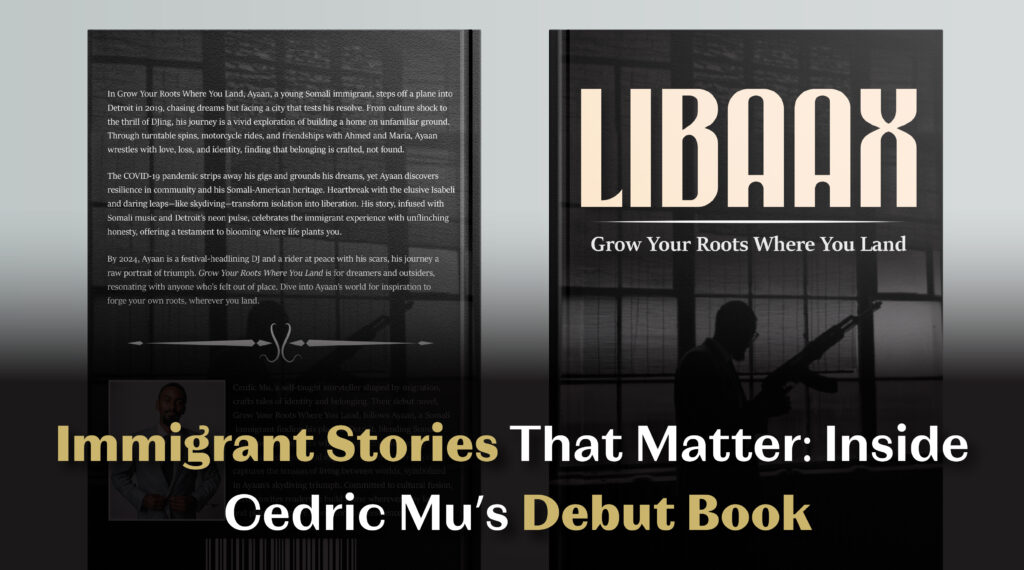
Libaax novel cover by Cedric Mu – immigrant stories in Libaax
Cedric Mu

Immigrant Stories That Matter – Inside Cedric Mu’s Debut Book

I remember the first time I heard a qaraami melody weave through the air, its lilting notes curling like smoke around the hum of a Detroit street corner. It was a sound that didn’t belong, yet it felt like home—a paradox I’ve carried since my own journey across borders. My name is Cedric Muhikira, and my debut book, Libaax: Grow Your Roots Where You Land, is my attempt to bottle that paradox, to give voice to the immigrant stories that pulse beneath the surface of every city, every life, every heartbeat. Cedric Mu’s Journey Shapes Libaax Writing Libaax wasn’t just about telling a story—it was about excavating the truths I’ve lived and witnessed. I grew up straddling cultures, my feet planted in two worlds that never quite aligned. One world spoke in the cadence of my childhood, rich with the smells of spiced tea and the laughter of aunties; the other demanded I learn its rhythms, its slang, its unspoken rules. In Detroit, where grit and soul collide, I found the perfect canvas to paint Ayaan’s story—a Somali immigrant who arrives with a civil engineering degree, a suitcase full of memories, and a heart heavy with displacement. Ayaan’s Story in Libaax: Raw and Real Ayaan’s journey in Libaax is not the tidy arc of tragedy or triumph we’re used to hearing about immigrants. It’s messier, more human. He’s scrubbing dishes one minute, spinning records the next, layering Somali qaraami melodies with trap beats as DJ Ayaan. His motorcycle, named Libaax, becomes his escape, his rebellion, his way of painting sagas on the asphalt. “He wasn’t the guy who fumbled slang or froze at Kroger’s endless aisles,” I wrote. “On Libaax, he was elemental—a streak of fire painting sagas on the asphalt.” That line, to me, is Ayaan’s heartbeat—his refusal to be reduced, his insistence on becoming. Inspiration Behind Cedric Mu’s Libaax Late-night conversations with first-generation youth, former refugees, and dreamers—people who, like me, know the ache of being ‘almost understood’—inspired this book. I wanted to capture the in-between moments—the dishwashing jobs, the fleeting romances, the friendships that stitch you back together. Ayaan’s connections with Ahmed, a reformed pirate with a quick laugh; Maria, a law student with a sharp mind; and Isabeli, a bartender whose fire matches his own, are the threads that hold his story together. These relationships, like the city of Detroit itself, are raw, vibrant, and unapologetic. Crafting Libaax: Cedric Mu’s Creative Process Writing Libaax was like building a mixtape. I’d blast qaraami and trap, letting the beats guide my pen. One of my favorite moments was crafting Ayaan’s first DJ gig—a scene where the club’s pulse syncs with his own, where every scent, flicker of light, and bass drop feels alive. The challenge was staying honest. Migration isn’t a monolith; it’s not all pain or all victory. It’s the stubborn beauty of carving space in a world that doesn’t always make room for you. I wanted Ayaan’s story to honor that complexity without romanticizing or pitying it. Why Cedric Mu Chose Immigrant Stories Why immigrants? I am one. I know the weight of carrying a story that doesn’t fit neatly into someone else’s narrative. Too often, we’re flattened into statistics or stereotypes, our truths buried under headlines.Ayaan’s story is a composite of so many real ones—young men who dream big, stumble hard, and keep dancing anyway. Through him, I explore displacement and identity, music as resistance, and the poetry of seeking home in unfamiliar places. I delve into masculinity and vulnerability, showing Ayaan’s emotional interiority, and celebrate the chosen family that anchors us when roots feel out of reach. Who Is Libaax For? Libaax is for anyone who loves stories that sing—adult and young adult readers drawn to immigrant narratives, urban fiction, or coming-of-age tales with lyrical prose. It’s for educators, social workers, and students diving into diaspora studies. It’s for anyone who’s ever felt like they’re remixing their own culture to fit a new world. What makes it unique? Its fusion of music, emotion, and urban grit. It’s not just about trauma or assimilation—it’s about how we rebuild joy, forge new rhythms, and claim agency in the chaos. Cedric Mu’s Vision for Libaax I hope Libaax does more than entertain. My wish is for readers to see immigrants as fully human—funny, fierce, flawed, and luminous. For immigrant readers especially, I want the story to reflect their experiences and help them feel less alone. For others, I hope it sparks empathy, curiosity, and a hunger to listen. This book is my bridge, my offering, my way of saying: these stories matter. Join Cedric Mu’s Libaax Journey You can find Libaax: Grow Your Roots Where You Land on Amazon or learn more at cedricmuhikira.com. I’m thrilled to host digital readings on Zoom, visit book clubs, and sign books at an independent bookstore in Detroit this fall. These events are about more than the book—they’re about fostering conversations on migration, identity, and storytelling through music. Stay tuned for dates and details by following me on social media. Cedric Mu’s Call to Listen This is just the beginning. Ayaan’s story, and the stories of so many others, are still being written—on vinyl, on asphalt, in the quiet moments of becoming. I hope you’ll join me in listening to their rhythm.

LIBAAX: Grow Your Roots Where You Land
LIBAAX - Immigrant Journeys

From Newcomer to Narrator: Cedric Mu’s Journey in Writing LIBAAX: Grow Your Roots Where You Land

I’ve always believed that stories are like vinyl records—each scratch, each groove, holds a piece of someone’s soul. Growing up between cultures, I felt those grooves in my bones: the ache of not quite belonging, the pulse of defiance in carving out my own space, the hum of resilience that kept me moving forward. That’s where LIBAAX: Grow Your Roots Where You Land was born—not just from my own journey as an immigrant, but from the countless voices I’ve heard in the vibrant, gritty streets of Detroit. Writing this book wasn’t just about telling a story; it was about spinning a mixtape of lives too often left unheard. Cedric Muhikira’s Roots – A Storyteller’s Beginnings My name is Cedric Muhikira, and I’m a storyteller, though I haven’t always called myself that. As a kid, I straddled worlds—different languages, different customs, different expectations. I was the boy who could slip between accents but never quite felt at home in any of them. Those early years taught me to listen closely—to the silences as much as the words. When I moved to Detroit, I found a city that mirrored that in-betweenness. It’s a place of raw edges and warm hearts, where people rebuild from the ground up. That’s where I met the real-life versions of Ayaan, the heart of LIBAAX: young immigrants scrubbing dishes, dreaming big, and remixing their cultures into something bold and new. LIBAAX – Ayaan’s Story of Resilience Ayaan’s story came to me in fragments, like a half-remembered song. He’s a Somali immigrant, a civil engineer by training, who lands in Detroit with a suitcase of memories and a heart full of grief. By day, he washes dishes; by night, he spins records, blending Somali qaraami melodies with trap beats as DJ Ayaan. His journey isn’t the glossy triumph or tear-soaked tragedy you might expect from an immigrant tale. It’s messier, more human—full of late-night motorcycle rides on his beloved Libaax, fleeting romance with a bartender named Isabeli, and friendships with people like Ahmed, a reformed pirate, and Maria, a law student with her own battles. Ayaan’s story is about finding rhythm in the chaos, about growing roots where you land, even when the soil feels foreign. Cedric Mu’s Writing Process – Building Bridges Writing LIBAAX was like building a bridge between my own experiences and those I’ve witnessed. I drew from late-night talks with first-generation youth, former refugees, and dreamers who’ve learned to dance through displacement. I wanted to capture the moments that don’t make headlines: the sting of mispronounced names, the quiet pride of a well-cooked meal, the way music can stitch together a fractured identity. Detroit became more than a setting—it was a character, with its pulsing underground music scene and its stubborn refusal to give up. I spent hours wandering its streets, listening to trap beats and qaraami mixes, trying to weave that energy into Ayaan’s world. Crafting Ayaan’s World in LIBAAX One night, while writing the scene of Ayaan’s first DJ gig, I locked myself in my apartment with a playlist of Somali classics and Detroit’s finest hip-hop. The air smelled of coffee and possibility. I wanted readers to feel the sweat on Ayaan’s palms, the thump of the bass, the way the crowd’s energy lifted him from a nobody to a narrator of his own story. That chapter was my favorite to write, but it was also the hardest. I wrestled with staying honest—not romanticizing the struggle or glossing over the loneliness. I wanted Ayaan to feel real, like someone you’d meet at a corner store or a dimly lit club, someone who’s flawed but fiercely alive. A Favorite Line from Cedric Mu’s LIBAAX “He wasn’t the guy who fumbled slang or froze at Kroger’s endless aisles. On Libaax, he was elemental—a streak of fire painting sagas on the asphalt.” This line, one of my favorites, captures Ayaan’s transformation. It’s not about becoming someone new but about reclaiming who he’s always been. That’s the heartbeat of LIBAAX: the idea that immigrants don’t just survive—they create, they remix, they burn bright. The book explores displacement, identity, and the search for belonging, but it also celebrates the poetry of everyday resilience. It’s about the friendships that anchor us, the music that carries memory, and the courage it takes to be vulnerable in a world that often demands toughness. Why LIBAAX by Cedric Mu Matters I wrote LIBAAX for anyone who’s ever felt like an outsider, but especially for those who’ve crossed borders—physical or otherwise—and had to rebuild themselves. It’s for young adults, educators, social workers, and anyone who loves stories that pulse with emotional depth and cultural richness. Unlike other books on immigration, LIBAAX doesn’t dwell on trauma or assimilation alone. It’s lyrical, raw, and unapologetically poetic, blending urban grit with the soul of Somali tradition. It’s a story that invites you to listen closely, to feel the beat, to see the beauty in becoming. Cedric Mu’s Vision for LIBAAX My hope is that LIBAAX does more than entertain. I want it to spark conversations—about immigration, yes, but also about the universal search for home. I want readers to walk away with deeper empathy, to see immigrants not as “others” but as neighbors, dreamers, storytellers. For those who see themselves in Ayaan, I hope they feel seen, too. This book is my love letter to them, to Detroit, to the stubborn beauty of starting over. Join Cedric Mu’s LIBAAX Journey If you’re curious to dive into Ayaan’s world, you can find LIBAAX: Grow Your Roots Where You Land on Amazon or learn more at cedricmuhikira.com. I’m thrilled to share that I’ll be hosting digital readings on Zoom, visiting book clubs, and holding a book signing at a Detroit indie bookstore this fall. These events are a chance to connect, share stories, and keep the conversation going. Follow me on social media for updates on dates and how to join. Cedric Mu’s Final Note Writing LIBAAX has been my own journey of growing roots. It’s taught me that stories don’t just reflect who we are—they shape who we become. I hope Ayaan’s

Scroll to Top